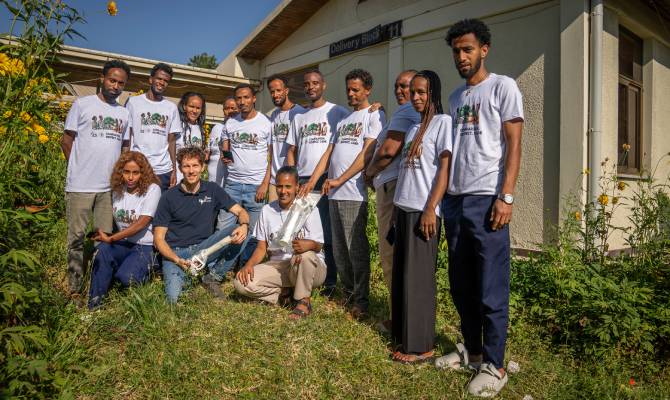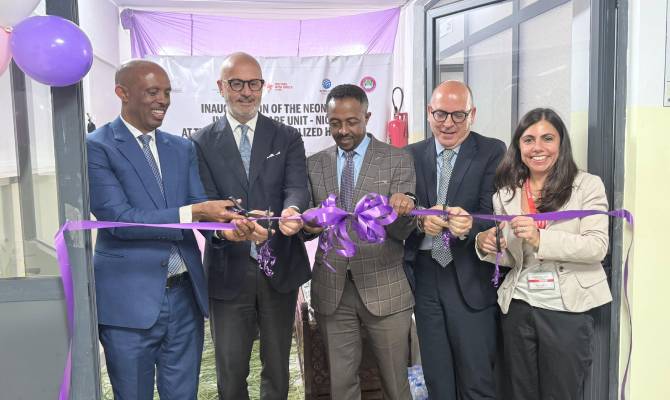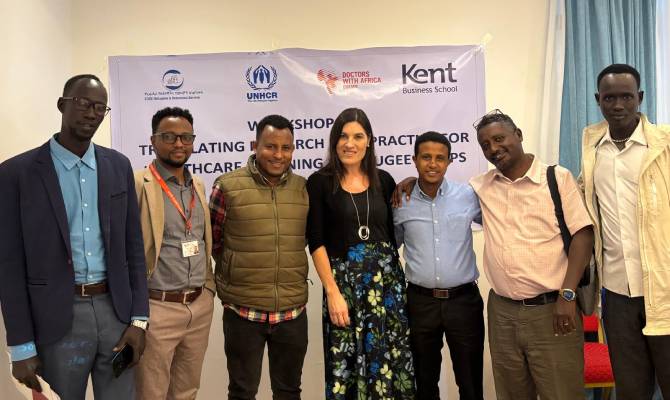
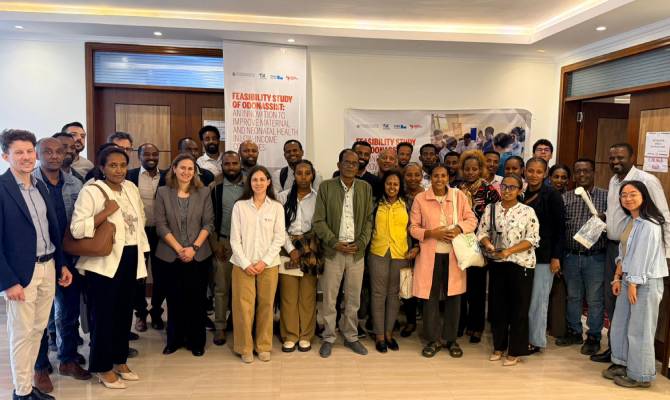
We recently hosted a dissemination workshop for the OdonAssist™ study in Addis Ababa, Ethiopia—an important opportunity for dialogue and reflection on how its findings can help improve maternal and newborn healthcare practices.
The meeting brought together a wide range of stakeholders in maternal and newborn health, including representatives from national and regional institutions, clinicians, scientific societies, international agencies, donors, and policymakers. Participants included members of the Ethiopian Ministry of Health, Oromia Health Bureau, National scientific societies (EPS and ESOG), alongside key partners such as UNFPA, UNICEF, and the World Bank.
The workshop served as a platform to present findings from the feasibility study launched early last year in collaboration with the University of Besançon and St. Luke’s Hospital in Wolisso, as part of an initiative funded by the FID – Fonds d’Innovation pour le Développement.
“When we were presented with CUAMM’s project on OdonAssist™, we saw an opportunity to generate robust local evidence to improve maternal and neonatal healthcare in Ethiopia. For FID, this is just the beginning. The real question is: where next? Can the Odon device be integrated into Ethiopia’s health system? Can it be scaled up to reduce preventable deaths?” said Estelle Plat, FID Investment Officer.
These and other questions were addressed through the workshop as findings showed positive results in the use and application of OdonAssist™ in low-resource settings.
During the workshop, Dr. Betrán Lazaga presented the WHO Global Landscape on Assisted Vaginal Birth (AVB), providing an overview of global trends. She highlighted the steady rise in cesarean section rates alongside a decline in assisted vaginal births and outlined the recurrent complications associated with cesarean sections—particularly in low-resource settings, where they remain a leading cause of maternal mortality.
Key gaps identified by WHO and discussed during the event include:
- Strengthening training for assisted vaginal birth
- Improving communication between providers and patients
- Expanding access to pain management options
- Evaluating new technologies and service delivery models
- Supporting healthcare providers through targeted behavioral interventions
Against this backdrop, testing the device in low-resource settings is essential to understand its potential, practical application, and scalability—particularly where the need for safer, simpler solutions in case of complications during labor and delivery is most urgent.
According to the United Nations, there are approximately 130 million births worldwide each year, of which around 5-10% are expected to benefit from AVB. However, these figures drop dramatically in low-resource settings. Data from over 40 countries across Latin America and sub-Saharan Africa show that only a fraction of health facilities provide access to these services, largely due to shortages of equipment and trained personnel.
Making AVB both accessible and safe in low- and middle-income countries is critical for reducing maternal and neonatal mortality.
“It is not merely a clinical issue, but a structural one,” said Michele Orsi, gynecologist at the Policlinico of Milan and CUAMM Project Manager. “Ensuring equitable access to assisted vaginal birth also means reducing delays in the delivery of obstetric care. Achieving this requires interventions that go beyond training—addressing resource availability, workforce distribution, and adaptation to local contexts.”
In Ethiopia, where we conducted the feasibility study, most assisted births are performed by general practitioners – midwives, and health officers, while gynaecologists are largely limited to hospitals. In peripheral health facilities, assisted births are almost exclusively managed by non-specialist staff who are on the frontline of obstetric service delivery, as Dr. Teshome from St. Luke Hospital noted during the workshop. Strengthening skills and expertise among healthcare workers is therefore a priority.
Results from St. Luke HospitalAs part of the feasibility study, last year OdonAssist™ was introduced in the delivery room at St. Luke Hospital, Wolisso, allowing midwives, gynecologists and surgical officers previously trained to use the device for AVB. Throughout the study, 80% of assisted vaginal births were performed by midwives and surgical officers, achieving a 75% success rate. Typically, in this setting, epidural anesthesia is scarcely available in hospitals and completely unavailable in health centers. These results demonstrate that a simple, easy-to-use device like OdonAssist™ has the potential to significantly improve maternal and neonatal health outcomes.
The study had previously been conducted in the UK and France, where the tool was used by gynecologists, achieving success rates of 67% and 88% respectively. The findings from Ethiopia – where the device was used by midwives and surgical technicians are consistent with these earlier results, showing comparable success rates as well as similar benefits in terms of reduced neonatal trauma and pain experienced by women. The study conducted in Wolisso made Ethiopia the first low-resource country in Africa to participate in this type of research. Today, Ethiopia is the first and only country in which healthcare personnel have used OdonAssist™ operationally in a delivery room. |
“OdonAssist™ is not just a technological innovation—it is practical innovation in the field,” noted Dr. Getache Secretary General of ESOG.
Building on global trends of rising cesarean section rates and declining assisted vaginal births, discussions also addressed key research gaps. Particular attention was given to findings on the safety, accessibility, and acceptability of OdonAssist™ among both healthcare providers and women, highlighting its potential to expand access to quality obstetric care.
Dr. Merialdi, Chief Medical Officer at the Maternal and Newborn Health Institute, emphasized the patient-centered approach behind the device:
“All studies have been conducted with a focus on women’s needs. OdonAssist™ is one of the first obstetric devices evaluated directly from the patients’ perspective.”
Acceptability was in fact assessed immediately postpartum, considering both maternal and neonatal well-being. The data show that resulted in overall rates of episiotomies and spontaneous lacerations similar to those observed with the vacuum, while achieving lower average pain scores and a reduced need for analgesia. Evaluations of perceived safety, respect, and communication during labor confirmed high maternal satisfaction, with most women reporting a positive experience.
Comparisons between the two devices indicate that OdonAssist™ achieved similar levels of acceptability and satisfaction, suggesting that perceived benefits are influenced not only by the technique itself but also by healthcare providers’ approach and adherence to protocols. Furthermore, the use of the device did not increase maternal risks and appears to confirm a reduction in neonatal risks, consistent with previous studies.
In conclusion, the project demonstrates high acceptability among both women and healthcare providers, a favorable safety profile, and ease of use. The authors recommend further studies with larger samples to confirm and consolidate these preliminary findings.
“The feasibility study conducted in Wolisso represents, on a small scale, a wide range of low-resource settings. For this reason, we can conclude that the device is accessible and applicable and it can indeed be scaled-up – affirmed Michele Orsi. Now it is time to move forward and undertake a second study to evaluate its real impact”.