South Sudan Tragic ambush in Yirol

On the 7th of June, Doctors with Africa CUAMM vehicles, travelling in convoy in the far west area of Yirol West County, in Lakes State, South Sudan, were ambushed by unknown people, for unclear reasons. As a result, two CUAMM staff tragically died.

Mr Moses Maker, 35 years old, was working with Doctors with Africa CUAMM as Nutritionist. Initially deployed to Cuibet County, he had then moved to the eastern side of Lakes State, being based in Yirol Town and in charge of organizing and supervising all activities related to the prevention and treatment of acute malnutrition. In particular, he was involved in the integration of nutrition services in the health care package at primary health care facilities and within communities in Yirol West and Yirol East Counties.

Mr Abraham Gulung, 31 years old, was working with Doctors with Africa CUAMM as Driver. He was supporting all activities implemented by CUAMM staff jointly with Yirol West Country Health Department, as supervision visits to primary health care facilities and drugs or nutrition supplies last mile distribution.

On that tragic day, they had travelled together to assess the work done in some facilities and to preposition some food supplies stock before raining season.

They were serving their people with passion, spirit of sacrifice and dedication.

We embrace the pain of the families of our dear colleagues. Their loss is a great tragedy that strikes the Cuamm family and our service in a country that we hope will soon find stability and a path of authentic and lasting peace.

Health and vaccines in Karamoja tackle the emergency

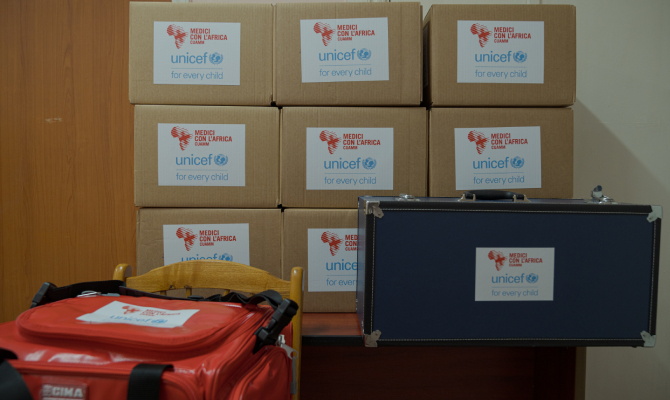
Today, May 21, marks the kick-off of a Doctors with Africa CUAMM’s project in partnership with UNICEF, in all nine districts of the Karamoja region in Uganda. The intervention aims to strengthen the health system to ensure better access to and use of quality health services with a focus on nutrition, HIV, and emergency health management including Covid-19. The project is particularly dedicated to the most vulnerable groups: women, children and adolescents, and it is part of a larger pre-existing programme of collaboration between UNICEF and the Ugandan government. The projects has the following main objectives:

  • Enhancing the capacity building of district authorities to plan, coordinate, implement and monitor integrated services, along with strengthening the capacity of health facilities to provide these services;
  • Increasing the involvement of communities to promote changes in attitudes and behaviours, and increasing demand for and use of integrated services.
  • Improving the capacity of prevention, preparedness and response to emergencies related to natural disasters and public health. In particular, in response to the Covid-19 pandemic, UNICEF has provided additional funding to help Doctors with Africa Cuamm in implementing vaccination activities in the region in support of the Ugandan Ministry of Health, and in strengthening community awareness on Covid-19;

In Moroto, in the presence of the Ugandan Minister of Primary Health Care and the Country Representatives for CUAMM and UNICEF, an event is taking place to launch the project and the Community Engagement Strategy, the ministerial strategy for community engagement to ensure that people are adequately sensitised and actively contribute to prevent and control the spread of the virus. To achieve broader community engagement, special attention will be paid to raise awareness on this strategy among religious leaders.

Voices from the Front Line The World in the Time of COVID-19

From the global North to the global South, from the world’s metropolises to its most rural areas, nowhere has been left unscathed by the COVID-19 pandemic, making all of us more aware than ever of our shared vulnerability, and underscoring the fact that health is a global issue that needs to be dealt with as such.

It’s precisely for this reason – to move beyond national boundaries and examine the pandemic from a global perspective – that Doctors with Africa CUAMM has put together a series of virtual meetings, “Voices from the Front Line: The World in the Time of COVID-19”, as part of our organization’s Italian Response to COVID-19 program, to be broadcast thanks to the support of the United States Agency for International Development (USAID).

The five events will offer firsthand accounts by those who’ve been fighting on the front lines against COVID-19 in various parts of the world: health workers including doctors, nurses and researchers as well as others from public, private and non-governmental organizations.

What kind of strategies have been the most effective in terms of ensuring the continuity of health services, and where have they been implemented? Will the global South get the vaccines it needs? How has international development cooperation been impacted by COVID-19? How hard has the pandemic hit women, and how important will their contribution be vis-à-vis the reopening of society? These are just some of the questions we’ll be looking into as we attempt to identify good practices and models that can be shared on an international level.

The talks will be streamed live in English on Doctors with Africa CUAMM’s Facebook and YouTube channels starting 26 May 2021.

Event schedule

26 May 2021, 6 p.m.
Public and private accounts from Italy and Germany during the COVID-19 epidemic
Register for the event

June 2021, 6 p.m.
Advancing international development in times of crisis
Register for the event

July 2021, 6 p.m.
Last-mile vaccination: a challenge or an opportunity for African health systems?
Register for the event

September 2021, 6 p.m.
Empowered women for more resilient communities
Register for the event

September 2021, 6 p.m.
The challenges facing female health-care workers during the COVID-19 epidemic
Register for the event

As Agnes and Patrick the story of Sierra Leone

Sierra Leone is one of the countries with the highest maternal mortality rate in the world, 1,120 maternal deaths per 100,000 live births, along with infant mortality rate, 78.5 deaths per 1,000 live births (UNDP, 2019). Behind these staggering figures are people, stories of women and children who face daily challenges and still too often lose their lives due to poor health practices, inadequate and ill-equipped health facilities.

Agnes and Patrick live in Bo, Sierra Leone, and their story fortunately had a different ending. They got married in 2013 and their greatest wish was to have a baby. Shortly after the wedding Agnes became pregnant but lost the baby during the first months of pregnancy. After several attempts, Agnes became pregnant again and together with Patrick decided to travel to Freetown in the hope of finding better health services for mothers and children. Despite their efforts to seek better care, a complication arose in the seventh month of pregnancy due to inadequate antenatal care visits, forcing her to undergo an emergency surgery which the baby did not survive.

“It was really hard for us” says Patrick. “After some time, Agnes became pregnant again and we undertook a new arduous journey looking for better assistance than that we had received in Sierra Leone”. The first stop was Ghana, with the hope of obtaining a visa to go to Canada, where Patrick’s brother Mustapha lived. Then Nigeria, where the pregnancy was interrupted again in the third month. Finally, they returned to Sierra Leone where Agnes and Patrick finally started a new chapter thanks to their meeting with Dr. Tiru Nitsuh Addis, an Ethiopian gynaecologist working in Bo with Doctors with Africa CUAMM.

“Dr Tiru’s approach was completely different from all the experiences we had had with other doctors. He asked us to tell him our story, our medical background, he listened carefully to my wife, her fears and our concerns about this new pregnancy after so many difficulties and losses we had experienced”, says Patrick. “He did a procedure called “cerclage” at 16 weeks of pregnancy, he supported us and followed us step by step throughout the months of pregnancy”.

And so, on 7 May, Divine was born. “I am so overjoyed that I can’t even eat. We are so happy and grateful to the Lord, to Dr. Tiru and to the hospital’s maternity team for everything he has done for us”, Patrick adds. “Now, after 12 years of uninterrupted work, I can stop for a while to take care of my wife and my little girl. Over the years, Agnes and I have experienced first-hand what poor and inadequate health care” continues Patrick. “I have witnessed how women suffer, I have seen how this country is losing women and children”.

What Patrick and Agnes have experienced is not a unique or an exceptional case, but the story of many couples, many women forced to deal with a health system that is still too fragile, where there is a shortage of medical equipment, drugs and above all of qualified and motivated health personnel. “We absolutely must invest in education and training, not only here in Bo but throughout the whole country”.

TAKING CARE OF THOSE WHO GIVE CARE FIT4CARE EXPERIENCE

Fit4care  was presented last week in Padua with an online event with many participating guests. This is an innovative course for the well-being of health professionals that Doctors with Africa CUAMM is developing with the unconditional contribution of MSD Italia, as part of the “Italian Response to Covid-19” project, funded by the United States government through the United States Agency for International Development (USAID).

Super-heroes, angels, guardians of life, the only contact between Covid-19 patients and their families: health workers have been all this and so much more, for all of us, over the last year and a half. This all makes investing in health workers and their well-being a necessity in Italy as well as in Africa, as Doctors with Africa CUAMM has seen every day for 70 years in the 8 countries in which it operates. CUAMM wanted to do more than just thank them by finding a practical way to “take care” of them, to improve and promote their health and their training. Thanks to the support of the American government through the “Italian Response to Covid-19” project, along with an unconditional contribution of MSD Italia, two special training courses were created, Fit4Care and JustInTime, which are starting to bear their first fruits, presented today.

The initiative is part of Doctors with Africa CUAMM’s work in Italy. When the pandemic broke out, CUAMM immediately took action in Africa to support the safety of health workers in the 23 hospitals in the 8 countries in which it operates. In Italy, in spring 2020, it also donated respirators to several hospitals in northern Italy. Since June 2020, CUAMM has been involved with “Italian Response to COVID-19: Improving Governance and Community Preparedness for a Resilient Society (IRC19).”

Project focus: supporting health facilities; helping vulnerable groups such as the homeless in La Spezia and immigrants in Puglia’s ghettos; raising awareness on issues such as global health; and training health personnel, the focus of this initiative.

“COVID-19 has been devastating for both of our countries, but our cooperation in the midst of the pandemic shows the strength of the bonds between Italy and the United States. We will stand by Italy, and together we will overcome this difficult time. With the Fit4Care program that CUAMM is launching today, we can give extra support to the medical personnel working on the front lines, treating the sick, administering vaccines, and making it possible for hospitals to function,” said the Chargé d’Affaires of the United States Embassy in Italy, Thomas Smitham.

“We are now well aware of the repercussions on mental and physical health caused by Covid-19, which have been recently described in the BES 2020 report from ISTAT. This is why MSD Italia wanted to support this initiative that CUAMM is presenting today. We see health workers as the ones most exposed, in every respect, in all the hardest phases of the pandemic and so deserving of special attention, beyond our enormous gratitude for the help they have given our country,” says Nicoletta Luppi, President and CEO of MSD Italia. “We wanted to focus our support on Fit4CARE to help health personnel in an innovative way in the regions of Southern Italy, where they had to give their tireless hard work and great professionalism, especially in the most critical phases of the emergency, to compensate for the shortcomings of the national health service which, unfortunately, is still not at the same level throughout the country. This is because we believe that investing in people and health is investing in the future.”

“Solidarity consists of practical actions, and training is one of these, which has the important value of generating real change, as we see every day in Africa and Italy,” said Don Dante Carraro, director of Doctors with Africa CUAMM. Training has always been central to Doctors with Africa CUAMM’s mission and remains a cornerstone of what we do. CUAMM has been working for years with 39 universities in Italy to create Global Health courses and in the field training of young doctors and medical students. A few numbers can give an overview of the work done: 256 Italian medical residents have gone to Africa with CUAMM from 2002 to the present, and 327 students from SISM (Italian Secretariat for Medical Students) have gained experience in one of our field projects. It is a unique opportunity to experience medicine consisting of having only basic tools at hand that make them have to find solutions. Now more than ever, this has great value, because the pandemic has shown us that we’re all vulnerable and we may also not have all the tools.”

Pietro Giurdanella, councilor of the FNOPI Central Committee said, “We support and encourage the work of Doctors with Africa CUAMM and its professionals, because what they do is made up in large part of the cultural and professional knowledge of nurses, especially considering the difficult circumstances in which they are working. The hospitals and settings in which Doctors with Africa CUAMM works are also the places, people and actions of the nursing profession, whose cardinal principle is “caring for others.” Mothers and children, from pregnancy to childbirth, in the neonatal period, during their growth and their adolescence, are among the most important people we care for, both because of their fragility, like that of older populations, and because it is with them that an awareness of health must be born and grow. This must be fostered from the start so that it can be understood and really shape populations that would otherwise be at high risk. We consider the creation of the role of the transcultural nurse as a great achievement we have made in those countries where different cultures coexist.”

“For over 70 years Doctors with Africa CUAMM has invested in the training of doctors, nurses and local staff in Africa,” says Andrea Atzori, Chief of Party of the IRC19 project. CUAMM decided to draw on the strength of this wealth of knowledge and experience to help in Italy as well, forming a network with other important organizations to make a contribution to a new approach that puts the focus on health professionals, not only by training them to manage the emergency specifically but also taking care of their complete mental and physical well-being. Five hundred health workers were trained from March 1 to April 30, including 200 students and 300 workers at numerous health facilities.”

This press release was made possible thanks to the generous support of American citizens through the United States Agency for International Development (USAID). The content is the responsibility of Doctors with Africa CUAMM, recipient of the Fixed Amount Award (FAA) No. 7200AA20FA00013 and does not necessarily reflect the views of USAID or the United States government.

COURSES

Fit4Care and JustInTime

  • Fit4Care was developed jointly with industry experts and sponsored by the Presidency of the Council of Ministers. The course is intended for all social and health workers, aiming to be a chance for training and focus on their physical and psychological well-being. The goal is to give them simple, easy-to-appy tools to improve their health and well-being that these months of emergency have often undermined.
  • JustInTime gives priority non-clinical training, focused on emergency management in health facilities and work organization in emergency settings. This training package was developed with the Research Center in Emergency and Disaster Medicine (CRIMEDIM) of the University of Eastern Piedmont. It is intended for all social and health workers.

Nurses: close to the patients the backbone of health systems

What would a hospital do while struggling with daily emergencies and the extraordinary one of Covid-19, without nurses? Very little. For this all over the world, nurses have been a symbol of dedication and care and the true backbone of health systems. In Africa, where healthcare is even more brittle and medical staff is often lacking, the role of the nurses is even more crucial.

Matilde Adelghi works now as a nurse at the Lui hospital in South Sudan, after her experience on the front line in Lombardy during the first wave Covid-19 of march 2020:” Being on the frontline of Covid has certainly helped me a lot, both for the managing and logistic point of view. My experience was useful for the organization of the isolation tent for suspected cases of Covid-19 and we have also developed a very dense training course of three days, which was particularly appreciated by nurses, where we dealt with the themes of dressing and undressing and the correct use of personal protective equipment (PPE). The experience in Italy allowed me to transmit not only theoretical knowledge but also what I’ve learned in practice”.

Doctors with Africa CUAMM in South Sudan is also involved in staff training, supporting the Nursing and Midwifery School of Lui, a training that does not only mean investing in technical and specialist knowledge, but also convey motivation to students and nurses, working on their professional identity so that they feel proud of playing an important role within the health system.

“I believe it is essential to train nurses so they can be aware of their role – tells Matilde -. The most important aspect remains dialogue and exchange to tackle critical issues together, trying to encourage people to think about the solution to problems. The nurse has a privileged view on care – continues Matilde – because works alongside the patient and is exposed to all their needs that often go far beyond just health. If the nursing is of high quality, it can really make a difference”.

Today, on World Nurses Day, it is more important than ever to recognize the essential role that this professional figure plays in patient care and assistance in Italy as well as in Africa.

A gaze that opens up again

In Uganda, in the northern regions of Acholi and West Nile, the situation as regards visual health is worrying: there is a shortage of qualified specialist doctors, and health centres do not provide appropriate eye care services due to the lack of instruments and equipment necessary to tackle visual diseases.

Doctors with Africa Cuamm with CBM Italia (Christian Blind Mission) intervenes in these regions through the project “Foreseeing Inclusion” that aims to contribute to the reduction of avoidable blindness and that also invests on the training of health workers: 1,012 those trained in 2020 in order to sensitize communities on visual diseases, organize the fields of ophthalmic surgery and take care of the periodic monitoring of patients.

The beneficiaries of the project are many and with various diseases, from those suffering from simple cataracts that over time caused blindness, to those who became blind as a result of trauma. The stories of the people we meet every day in the field underline how simple surgery like the cataract removal can change life and their families.

Abdala, a 60-year-old refugee from the Imvepi camp in the Terengo district, suffered cataracts for at least 5 years before surgery: “It was like living constantly in the dark. First, I lost sight in 2018 and after two years, I became very blind. Little by little, I found myself needing help to do anything, even the simplest. My wife had to take care of me 24 hours a day and I am very grateful for this – she says – as well as thank the staff of Medici with Africa Cuamm and CBM for convincing me to do the surgery that gave me the opportunity to see“.

Thanks to artificial intraocular lenses, the day after the operation, Abdala has normally recovered the sight to the right eye. “I am now autonomous again and have a normal life without having to constantly ask my wife for help”.

The story of Isaya, a 47-year-old refugee from the Rhino camp, was blind for 27 years after stepping on a mine. “A lot of people like me lost their sight after stepping on a land mine. Living without being able to see and be autonomous is a great suffering, I could not move alone, work to support my family, I felt useless and often mocked for my fragility. I tried to go to many hospitals but no one could solve my problem. – Says Isaya -. Fortunately, a Cuamm health worker from the Village Health Team advised me to go to the Ofua health center and I asked my brother to accompany me because I did not want to give up. I was able to operate and thanks to the surgery, I saw the face of my wife, of my children. Now I can finally see what I haven’t seen in 27 years“.

The stories of Abdala and Isaya are just some of the many happy ending stories made possible thanks to the project “Foreseeing Inclusion”, which aims to improve the quality of life not only of people who undergo visits and interventions, but also of their families.

Being a midwife in Wolisso: a training ground

Elena and Chiara are two young midwives who chose to practice their profession in Africa. Elena left in mid-April and is currently in Wolisso, Ethiopia, thanks to a collaboration between the Rachelina Ambrosini Foundation, the University of Salerno and Doctors with Africa CUAMM. Chiara leaves today, May 5, World Midwife Day, and she will soon join Elena.

The midwife is the one who takes care of managing the delivery, assisting the mum and the newborn. This profession, often undervalued in the Western word, in Africa it is more essential than ever: it is necessary to enter the lives of women step by step, to learn about the traditions, the language, the living habits, and to respect them in order to help bring new lives into the world.

“The shifts in the hospital are intense, Wolisso’s St. Luke records more than double the number of births compared to Italian birth centers – says Elena. We work 10-11 hours a day, and it is a real “training ground”, a continuous stimulus. Ethiopian obstetricians immediately welcomed me into the team, never making me feel different. I rediscovered the beauty of diversity and the richness of those feelings that have no differences of borders or color”. An example of sensitivity and hospitality, precious also in Western contexts, that are now multicultural. “In such a challenging environment, with dramatic stories of real suffering and discomfort, every day I learn the medicine of the senses: a real art, especially for obstetrics. Semiotics is a great wealth, which we often forget where everything is safer, modern and equipped. Here, the disease and the emergencies are on the agenda and the team is not always fully staffed. Often the gynecologist is elsewhere, and reaches hardly the delivery room. Therefore, the presence of obstetricians makes the difference. I am really proud to be part of this team”.

Chiara, on the eve of her departure, tells us the reasons why she chose to leave: “Africa has always fascinated me and in my Italian experience I had the chance to witness the deliveries of some African women. I was very surprised by their naturalness and spontaneity in dealing with this delicate moment of life, as if they were able to listen to their body very deeply, something that we have lost a bit in the Western world. I chose to leave in order to better understand this aspect that is very intriguing to me. I expect to learn a lot, both humanly and professionally and to discover the origins of this profession that I love so much. I believe that experiences like the one I am about to undertake will give the chance to change the point of view, always providing a reason for growth”.

Elena, from Wolisso, seems to confirm Chiara’s expectations: “It’s an experience that is changing my way of seeing the world – concludes Elena. No more words are needed, it would be enough to look at my eyes, full of emotion. I can almost say that I am another person: I feel enriched, professionally and humanly. ‘What you get from being in Africa is not even comparable to what you may give’. I can thus only say thank you. Ameseginalew, indeed”.


To be a logistician in the last mile

The logistician is a little-known figure in the field of international cooperation: he is behind the scenes, yet he puts everyone else – doctors, nurses, midwives, drivers – enabled to operate, in the best possible way in a given context. “It’s logical” we say when an intervention is coherent and well organized. This is the task of the logistician: to make the interventions well organized and working. With infinite differences, depending on the different contexts.

“Being a logistician for a hospital and, in my case, for the Bangui children’s hospital, means not only following the entire supply chain of medicines and medical supplies that goes from purchase to delivery, making sure it arrives in time and quantity pre-established, but also take care of all the necessary equipment, from the maintenance of the hospital to the stationery, in addition to being always operational for any malfunctions or repairs. Being a logistician means taking care of everything that is supporting the project,” explains Andrea Martino, who recently returned from Bangui after 14 months of service.

Central African Republic is a difficult and unstable country from all points of view: a reality with which you have to deal especially if your task is to ensure a constant supply of medical material in a time of pandemic and in the midst of a difficult electoral period.

“When the pandemic broke out around the world in March 2020, we felt a strong impact in RCA too, not so much in terms of cases – very few were officially registered in the country – but because of the blockages and slowdowns in the arrival of the material. Priority was given to all the protective material from Covid-19 but here in the hospital we continued to need even the usual medicines and materials that no longer arrived – says Andrea -. During the election period the blockade was even worse because it was total. Because of the guerrillas that exploded all over the country, the borders were closed and all the drivers who arrived from Cameroon with the most diverse materials were stuck at the border fearing to cross the country. More than 1000 blocked containers; food also started to decrease while increasing in price”.

Being a logistician is a daily challenge, you have the opportunity to live the hospital but you also live its backstory and the “behind the scenes” who allow to set in motion this huge and complex care machine. “If I have to think of an image of myself in Central Africa I think of when I entered the pharmacy greeting all the staff with a “Bonjours pharmacy”. I think it is a representative image of the close link between pharmacy and logistics, which does not always happen but that was definitely a strong element of this mission – remembers Andrea, about to leave for Central Africa, this time for a short mission-. This experience, the third in logistics and the second in Africa, certainly had a positive balance and gave confirmation to my intention to keep working in cooperation and in particular in the field of logistics.”

A role with a thousand facets that of the logistician: so to speak “technician of the lights, of the sound and curator of the preparation” of the great daily challenge of the health of mothers and children.

Emergency Cyclone Eloise in Mozambique

The night between January 22nd and 23rd 2021, Tropical Cyclone Eloise (category 1) made landfall in the already fragile Province of Sofala hit, exactly in Buzi District, 30 km south to Beira City, in central Mozambique. Torrential rains and winds of 120 km/h ravaged especially Sofala, but also reaching Zambezia, Manica and Inhambane provinces with devastating consequences for the local population of about 600,000 people. Sofala Province is still recovering from the tragic impact cyclone Idai had in March 2019 as well as from the tropical storm Chalane which hit again the Province on 30th of December 2020. Eloise is the second cyclone hitting Sofala Province in less than 1 month.

“In a country already battered by the Covid-19 pandemic and by humanitarian crises that have led more than 600,000 internally displaced people (IDPs) to the north of the country due to armed attacks and natural disasters, we are facing a situation that dramatically repeats itself – Giovanna De Meneghi, CUAMM country manager in Mozambique, tells us -. Almost 7,000 people have been forced to flee their homes and take refuge in temporary shelters offered by the government, with 32,660 families directly affected for a total of over 163,000 people, more than 5,000 homes have been destroyed, damaged or flooded. We are organizing the emergency response, with maximum speed, together with the other actors on the field (UN, government and other NGOs) in order to implement all those life-saving activities that are considered the most critical and that must be carried out as a priority. The population, although tired and exhausted by contingent and chronic emergencies, is reacting and responding with strength and determination to the reconstruction actions led by the government and supported by international partners and by the communities themselves”. Strong winds and massive flooding caused the destruction of local infrastructure, food production and reserves and disrupted the functioning of services, especially in the rural districts of Buzi, Dondo and Nahatanda and in the city of Beira.

Between the damaged infrastructures there are 11 health facilities and in particular the emergency wing of Beira Central Hospital and OPD was damaged severely and, especially the latter, is not operational. There was a severe damage to crops, including about 136,755 hectares already flooded. This means that the food security of the population is at risk as well as water supply which increase the risk of water borne diseases.

The priorities are clear and we are moving to act as soon as possible thanks to the use of over 80 community health activists:

  • Water supply, sanitation and hygiene promotion
  • Food Security and Nutrition for the people hitted by the cyclone
  • Immediate assistance and emergency relief
  • Outbreak prevention and preparedness via setting up dedicated wards (tents) and building up stocks of drugs, IV fluid, IPC equipment and consumables and deployment of over 50 community health activists already trained to raise awareness around Covid-19 and prevention of cholera and Acute Watery Diarrhoea (AWD);
  • Re-establish basic routine healthcare services: mapping current damage and promote immediate action to re-open/rehabilitate outpatient services, wards, operating theatre and laboratory. Priority will be given to the central hospital of Beira and the most affected health facilities.

CUAMM with his team of 40 people in Beira that is already taking action to provide an humanitarian response.