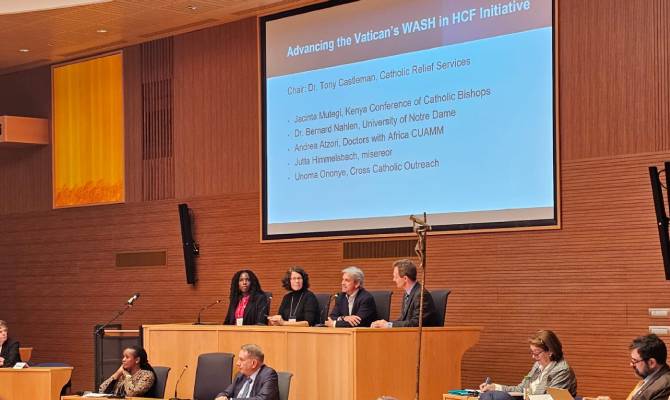
On April 22–23, we took part in the event “Committed to WASH in Healthcare Facilities: A Gathering of Faith-based Organizations and Allies to Accelerate Progress”, held in Rome at the Jesuit Curia. The global meeting brought together faith-based organizations and partners committed to improving access to essential services—water, sanitation, and hygiene (WASH)—in healthcare facilities, a need also highlighted by the United Nations.
The event aimed to secure concrete financial and operational commitments to strengthen WASH services in faith-based healthcare facilities. It also sought to accelerate new initiatives, foster collaboration with secular partners, and share lessons learned and future priorities.
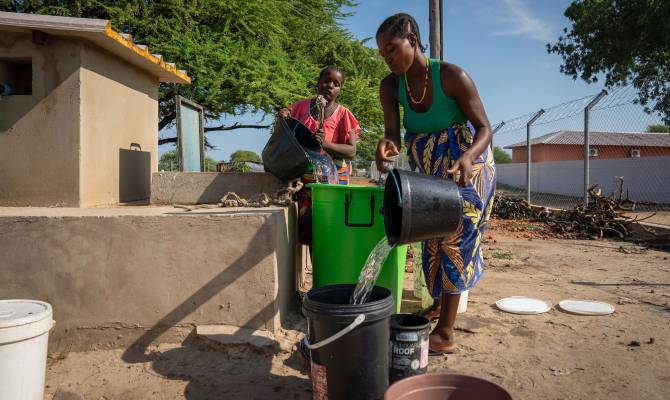
Throughout the discussions, a stark reality was repeatedly emphasized: across 60 low-resource countries, 37% of healthcare facilities lack basic water services and 81% lack basic sanitation. These gaps directly contribute to higher maternal and infant mortality, increased disease transmission, and deepening poverty.
“We all recognize how challenging it is not only to ensure, but also to sustain, WASH services in many health facilities,” said Andrea Atzori, Head of International Relations at CUAMM. “While the term ‘WASH’ may be relatively recent, the challenge of water access has persisted for decades—spanning infrastructure, maintenance, and long-term affordability.” He also highlighted how WASH is closely linked to CUAMM’s commitment to maternal and neonatal health through prevention.
This connection was echoed by Sean Callahan, President and CEO of Catholic Relief Services, who stressed that access to WASH “not only prevents infections and protects health—it also upholds the dignity of vulnerable patients. Every mother deserves clean water, private sanitation, and hygienic conditions when giving birth.”
The meeting also highlighted the critical role of women’s religious congregations and faith-based health networks in delivering healthcare and promoting human dignity worldwide.
Faith-based organizations (FBOs) are essential providers in underserved and hard-to-reach areas, delivering 30–50% of healthcare services in some low-resource countries. Despite their impact, their contributions are often overlooked.
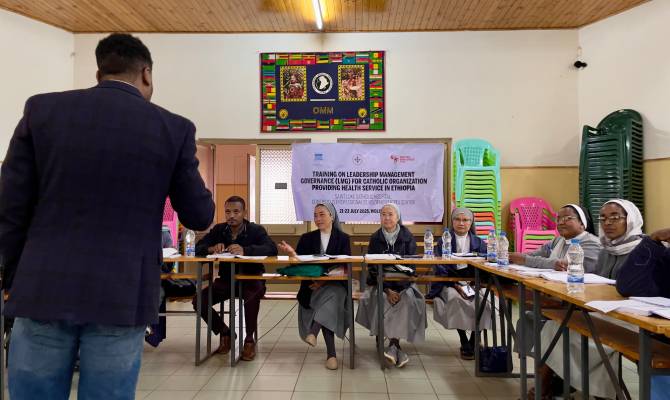
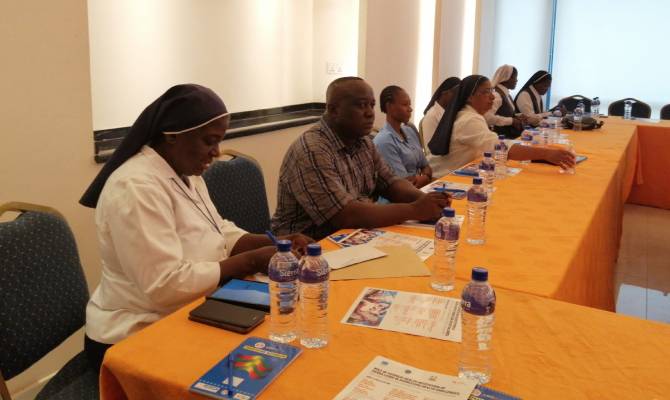
Recognizing this, since 2019 we have partnered with FBOs across Africa to strengthen their capacity, resilience, and participation in decision-making processes. Today, we support 93 Catholic congregations in 26 countries through training, technical assistance, and advocacy.
“While WASH is not our core area of expertise, we are committed to identifying sustainable solutions and integrating these services into broader health interventions by working closely with institutions, communities, and partners—including FBOs,” added Atzori. “This collaboration enables us to better understand challenges, co-develop practical solutions, and advocate more effectively for lasting progress.”
The two-day meeting provided a platform to exchange experiences and align on next steps. Participants—from religious leaders to field experts—called for scaling progress and “turning commitments into funded plans with clear targets and deadlines,” as noted by Alistair Dutton, Secretary General of Caritas Internationalis.
Cardinal Michael F. Czerny emphasized the urgency of action:
“Without WASH, healthcare cannot be safe. No treatment, surgery, or delivery can be properly performed. Ensuring these basic conditions is a fundamental step toward human dignity and integral development.”
Adding her voice, Sarah Mullally, Archbishop of Canterbury, stated:
“As a former nurse, I know that clean water and sanitation are essential to safe and effective healthcare. I am encouraged by the progress already underway and urge continued support for this vital work.”
Moving forward, the challenge is clear: transform commitments into concrete, funded actions that reach the most vulnerable. In this effort, the leadership of faith-based actors will remain critical. As Sister Irene O’Neill, Founder of Sisters Rising Worldwide, emphasized, “sisters see what others often miss, they remain where others do not and are already leading solutions that need to be heard, shared and scaled sustainably.” Scaling these solutions is no longer optional—it is urgent.
The event was promoted by a consortium of partners committed to advancing WASH in healthcare facilities, including CUAMM, Caritas Internationalis, Catholic Relief Services, the Daughters of Charity of Saint Vincent de Paul, Global Ministries/UMCOR, the U.S. Catholic Health Association, the Anglican Communion Health and Community Network, ACHAP, and Accord Network. It was held under the patronage of the Dicastery for Promoting Integral Human Development.