Over a billion people worldwide live with a neglected tropical disease (NTD).
These are 21 different conditions caused by parasites, bacteria, viruses, or fungi, primarily affecting the most vulnerable populations in low- and middle-income countries in tropical and subtropical regions.
January 30 marks World NTD Day, established by the World Health Organization to draw attention to a global health emergency that remains largely overlooked. In Karamoja, in northeastern Uganda, these diseases are not just statistics—they are part of daily life.
“Experiencing this day here gives it an even stronger meaning,” says Sara Biagioni, an Infectious Diseases resident at Matany Hospital. “Over these months, I’ve seen just how immense the problem is. Even for someone like me, who has already dealt with these conditions in Italy, their prevalence here is evident every day. The lack of attention and investment in diseases that predominantly affect vulnerable populations and regions marked by poverty and structural challenges is also striking.”
In a rural area where livestock farming is one of the main activities and the poverty rate is among the highest in the country, the social determinants of health are particularly apparent.
“You can fully understand,” she continues, “the interconnection between human, animal, and environmental health. It becomes clear how essential a One Health approach is to address the problem.”
Sometimes, prevention starts with actions that elsewhere we take for granted.
“I have often thought, with no small amount of frustration, that even before distributing medicines, simple measures could be enough for effective prevention—like wearing shoes or other adequate footwear.”
In this area, many people walk barefoot: parasitic infections transmitted through contact with the soil can cause anemia and malnutrition, compromising children’s development and the health of pregnant women. Diseases such as tungiasis and podoconiosis—common in some areas of Karamoja—can progress to chronic lesions, permanent disabilities, and severe mobility issues, compounded by the social stigma faced by those affected.
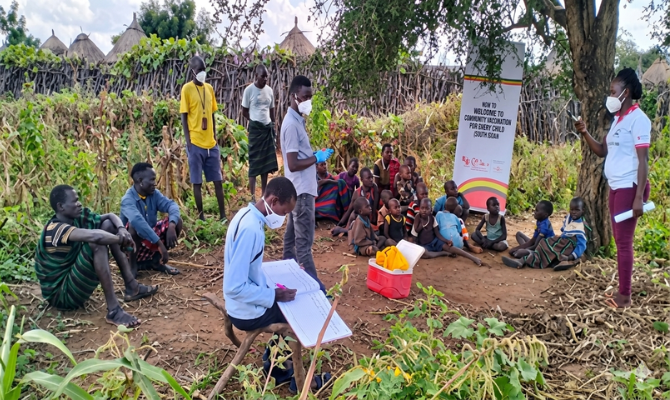
During the days when a Ugandan organization focused on patient care worked in Matany, Sara met people waiting in line for long-awaited consultations.
“With the team, we talked about the social stigma resulting from these conditions and how it complicates people’s lives. Among the patients present, I found genuine and surprised gratitude: in discovering that someone could care for their problem, but also in seeing the improvements achieved through simple measures.”
Among the diseases she has encountered most frequently in recent months is visceral leishmaniasis, an endemic condition in this area that can be fatal if untreated. Its management, however, is complex in Matany: diagnosis is not always immediate, and treatments require prolonged hospitalization and careful monitoring.
“These challenges made me realize how important it is to have constant collaboration with local colleagues, like Julius, a key reference for this condition at the hospital, or Sister Harriet, the head nurse, who on Sundays, after mass, comes to the hospital to ensure that therapy continues even on weekends. It’s a continuous exchange where knowledge is shared, but you learn something every day.”
Every case has a face.
“I remember every face, every name,” she says. Like Alice, who wanted to go home after her first injections because she felt better and stayed only after a heated discussion, later leaving us with one of the most ironic and grateful smiles. Or Anjelina, admitted in serious condition and discharged after weeks of treatment: today, she returns to the hospital only to say hello and give thanks—her last visit she chose to do in Italian.
Neglected tropical diseases are called so because they have long remained at the margins of the global agenda. But in Matany, they have names, stories, relationships. They remind us that the right to healthcare also depends on choices—like looking all the way to the last mile, working side by side with local communities, standing alongside the most vulnerable, and bringing commitment, change, and dignity even to those suffering from forgotten diseases.