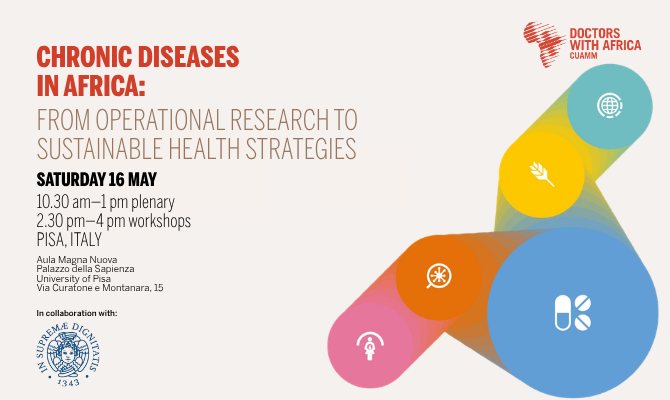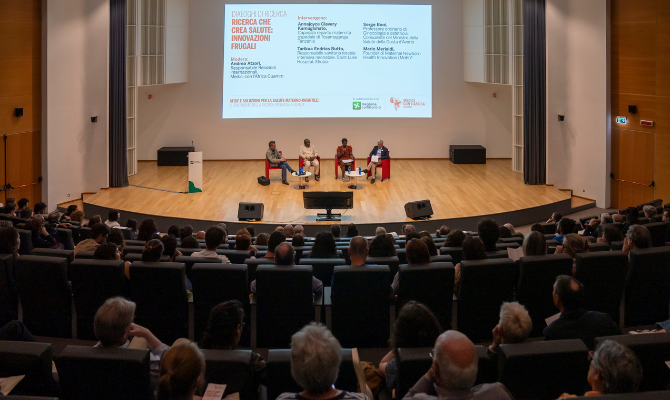
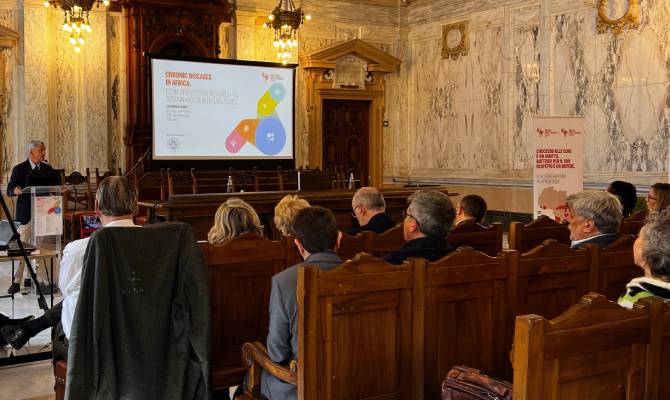
On Saturday May 16, leading international experts, researchers, clinicians, and institutional representatives gathered in Pisa for the conference “Chronic Diseases in Africa: From Operational Research to Sustainable Health Strategies”, promoted by Doctors with Africa CUAMM in collaboration with the University of Pisa.
Among the many challenges faced daily in Africa, chronic diseases are becoming increasingly urgent, demanding sustainable, concrete, and effective responses.
The event stemmed from the recognition that operational research is a fundamental tool for guiding effective health policies and interventions. It offered an important opportunity to discuss the growing burden of chronic diseases across African countries and to explore innovative, sustainable, and community-based healthcare responses. Contributions ranged from epidemiological data and global perspectives to the specific challenges faced by African countries, where poverty, limited access to healthcare, and inadequate policies create a vicious cycle of disease and economic hardship.
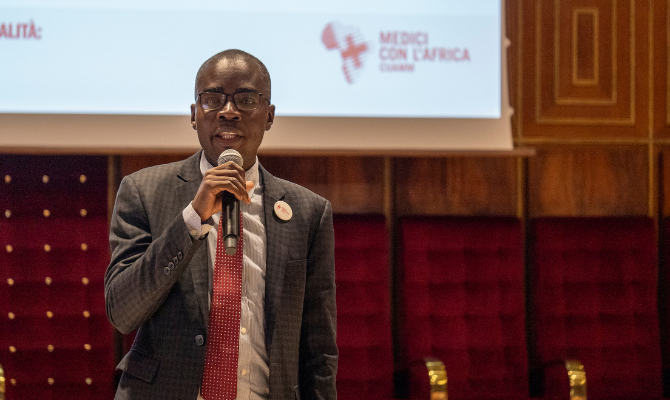
The morning plenary session opened with institutional greetings from Giovanni Putoto, Head of Programming and Operational Research at Doctors with Africa CUAMM and Riccardo Zucchi, Rector of the University of Pisa.
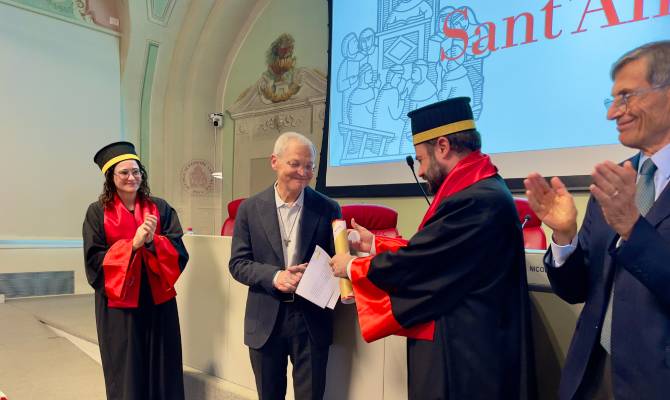
The keynote lecture, delivered by Prof. Paolo Mancarella, Director of the Department of Computer Science and former Rector of the University of Pisa started by recalling the origins of the collaboration between academia and CUAMM.
“During my time as rector, many international collaborations were established, and the one with CUAMM is among the strongest and most meaningful. Both our missions are grounded in research, knowledge production, and innovation, and we are equally committed to translating these elements into action within the most fragile settings.”
He then focused on innovation and the universal right to healthcare, emphasizing how technological and organizational innovation can contribute to more equitable health systems worldwide.
“Instead of continually asking what technology is capable of doing, we should investigate how it can adapt and contribute to reducing inequalities.”
Inequalities, poverty, and limited accessibility emerged repeatedly throughout the conference as key drivers of the growing burden of NCDs. Low socioeconomic status significantly increases the risk of conditions such as cardiovascular disease and diabetes because of poor nutrition and restricted access to healthcare, while the financial costs of treatment often push vulnerable populations deeper into poverty. Although the burden of NCDs is global, its impact is increasingly disproportionate in Sub-Saharan Africa, where NCDs are projected to become the leading cause of mortality by 2030, surpassing communicable and maternal diseases.
A central theme of the conference was the urgent challenge posed by chronic diseases in Africa and the need for integrated local responses. Gene Bukhman, Co-Chair of the NCDI Poverty Network and Professor at Harvard Medical School highlighted the impact of non-communicable diseases in low-resource settings and the importance of the PEN Plus model in strengthening healthcare systems for chronic care delivery.
“NCDs should not be understood as a narrow cluster of diseases, but as a broad and diverse continuum of chronic conditions. Their ‘long tail’ includes many neglected illnesses and risk factors that disproportionately affect vulnerable populations across Sub-Saharan Africa.”
He added:
“The NCDI Poverty Network is dedicated to eradicating poverty and severe non-communicable diseases wherever they exist. We support partners, governments, and organizations like CUAMM in providing the best possible care for populations in need.”
The conference also addressed the intersection between migration and health. Santino Severoni, Head of the Health and Migration Special Initiative at the World Health Organization, discussed the challenges of addressing chronic diseases among migrant populations and the importance of inclusive healthcare policies.
“Today, people on the move number more than 8 billion, meaning one in eight people globally. They include migrants, internally displaced persons, refugees, and asylum seekers, all of whom face multiple barriers in accessing healthcare services,” said Santino Severoni, Head of the Health and Migration Special Initiative at the WHO. “The prevention and treatment of NCDs is an urgent priority that ministries of health and governments must address in the near future. If asked where health funds should be invested, I would certainly say that NCDs are the priority.”
The expert panel discussion that followed brought together other international specialists including Colin Pfaff, Khadija Yahya Malima, Fabrizio Tediosi who shared perspectives on research, policy development, and practical implementation strategies in different African contexts.
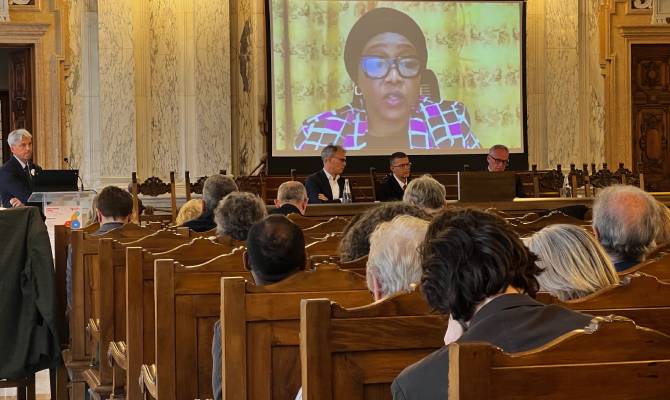
Khadija Yahya Malima, lecturer at Muhimbili University of Health and Allied Sciences, highlighted the often-overlooked links between infectious and non-communicable diseases. She stressed that in Sub-Saharan Africa many patients experience these conditions not as separate categories, but as interconnected realities requiring lifelong treatment, continuity of care, and integrated health responses.
The relationship between infectious diseases and NCDs was also addressed by Colin Pfaff, Associate Director of Programs at the NCDI Poverty Network. Pfaff acknowledged the progress achieved in HIV services as proof that health systems in Sub-Saharan Africa are capable of delivering long-term treatment and continuity of care at scale. However, he noted that NCDs have not generated the same level of public attention, political mobilization, or advocacy that shaped the global HIV response over recent decades. While HIV benefitted from strong community movements, international solidarity, and sustained investment, NCDs often remain comparatively invisible despite their growing impact.
“There are many lessons we can draw from the HIV experience to strengthen advocacy in the NCD space. HIV drew global attention because people were dying without access to treatment, but we are still witnessing the same reality with NCDs today.”
Pfaff concluded by asking how stronger advocacy movements around NCDs — particularly those focused on access to medicines and services for young people — can be built in order to promote integrated care, long-term financing, and patient-centred health systems adapted to the realities of chronic disease management in Africa.
Particular attention was dedicated to operational research experiences through a series of short presentations showcasing field projects developed by Italian medical residents in Tanzania, Uganda, Mozambique, and Sierra Leone. Topics included cardiovascular risk assessment in rural Tanzania, fatty liver disease among diabetic patients in Uganda, decentralized healthcare models, developmental assessment tools in Mozambique, and the implementation of the PEN Plus model for sickle cell disease care in Sierra Leone. The session highlighted CUAMM’s strong commitment to combining research, training, and fieldwork in order to generate evidence-based solutions tailored to local realities.
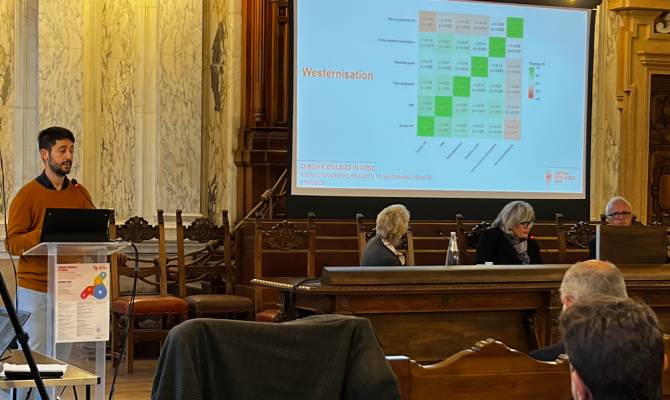
The morning concluded with remarks by Giovanni Torelli, Program Manager at Doctors with Africa CUAMM, who emphasized the importance of strengthening partnerships between academic institutions, healthcare professionals, and local communities to build resilient and sustainable health systems.
In the afternoon, participants joined thematic workshops focused on clinical service delivery models and Universal Health Coverage, insulin-dependent and atypical forms of diabetes, cardiovascular risk and complications, and disability assessment and rehabilitation care in Africa.
“This event was particularly important not only for placing our work within the broader international landscape — including the growing burden of chronic diseases, the implementation of the PEN Plus model, and the need to address the needs of vulnerable populations — but also for creating a space to share field experiences and the latest research findings in both clinical practice and health service organization,” said Francesca Tognon, CUAMM Operational Research Department. “With the contribution of highly distinguished international guests, the discussions highlighted how much still needs to be done and studied to effectively address these challenges. Operational research can play a crucial role in guiding interventions and informing policymakers.”
The conference reaffirmed the critical role of operational research, international collaboration, and local capacity-building in addressing the growing burden of chronic diseases and advancing equitable healthcare access across Africa.