What drives two midwives with years of experience in a major hospital in Lombardy to fly to Tanzania for a two-week training?
For Teresa Gramegna and Lucia Zagra, who have been working at San Gerardo Hospital in Monza for 12 and 3 years respectively, the answer lies in a scholarship from the University of Milano-Bicocca and in a special encounter that changed their professional perspective.
A meeting born miles apart
It all began within the walls of San Gerardo, thanks to an international exchange project (Erasmus+) between Bicocca University and Ruaha University College (RUCU) in Iringa. It is here that Teresa and Lucia met Annajoyce, head nurse of the gynecology ward at Tosamaganga Hospital.
“Annajoyce stayed with us in Italy for two months,” the midwives recall. “She was a quiet yet extremely attentive presence. We were struck by her attention to detail, from the precision in folding sheets to her deep, almost instinctive clinical observation of women and staff.”
It was precisely this human connection that built a bridge to Africa, where, as Doctors with Africa CUAMM, we have been working in the field for years with the program “Mothers and Children First. People and Skills.”
Training in Tosamaganga: learning how to teach
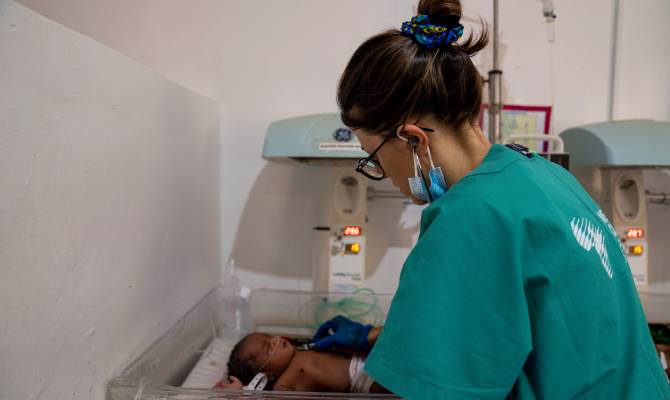
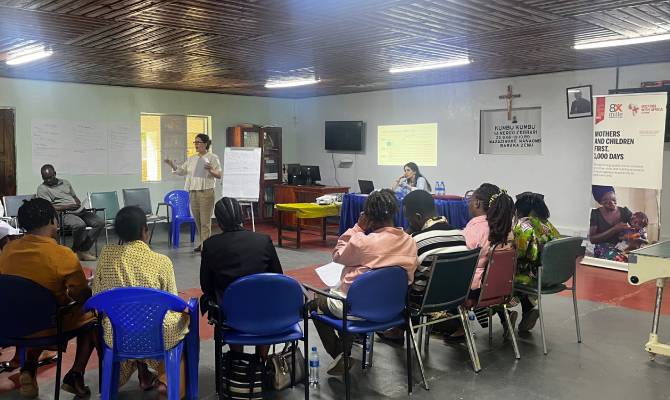
Upon arriving in Tanzania, Teresa and Lucia found themselves immersed in a reality where limited resources are balanced by an extraordinary capacity for adaptation and collaboration. The training, organized together with CUAMM staff and Annajoyce, was not a simple lecture but a dynamic exchange.
“We discovered a different teaching system, much more engaging, made up of energetic moments and collective repetition,” they explain. “There was no rigid hierarchy: doctors and midwives work in complete symbiosis, discussing every clinical case from the night together.”
The impact of the delivery ward was striking: small spaces where technology gives way to pure clinical skills. In a context where a woman has on average 3 or 4 children, the work focused on reducing cesarean sections and improving fetal monitoring—both complex challenges due to limited equipment and cultural differences.
Small changes, big impact
The core of the training focused on two fundamental pillars: freedom of movement during labor and monitoring fetal well-being.
Despite the objective difficulties, the training produced immediate results. Thanks to the willingness of local staff, small but meaningful changes were introduced: a sheet hung up to support free movement during labor, and a handmade birthing stool built by a local carpenter.
“We saw an immense desire to learn,” Teresa emphasizes. “After just the first week, we noticed improvements in monitoring fetal well-being. They taught us that even with little, you can achieve a great deal if there is cooperation.”
A rewarding return
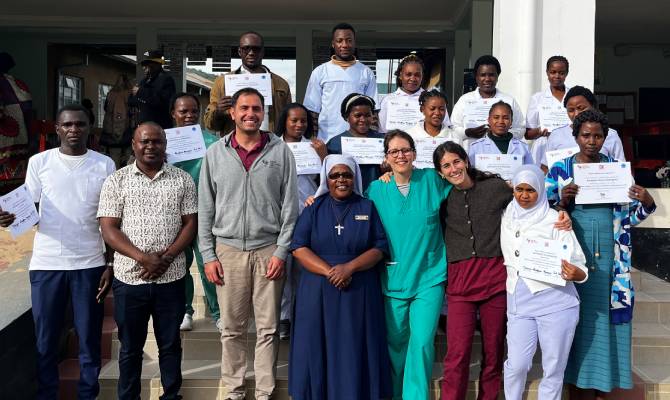
The experience in Tosamaganga ended with songs, dances, and hugs during the certificate ceremony, but the bond remains strong. For Lucia and Teresa, the outcome is extremely positive. From a clinical perspective, they bring home a greater capacity for observation and the importance of returning to the essence of their profession; on a human level, a new sensitivity toward foreign mothers giving birth in Italy: “Now we can better understand their fears and their background.”
Their advice to colleagues? “Do it—but do it together. Supporting each other is essential.”
Teresa and Lucia’s journey shows that international cooperation, supported by universities and organizations like CUAMM, is not just about transferring technical skills, but about mutual enrichment that makes the most delicate moment of life—birth—more humane.