In the Bossangoa Health District, in the Ouham Prefecture – one of the areas hardest hit by the crisis that has gripped the Central African Republic for over a decade – nearly 186,000 people reside. In this context, accessing healthcare remains a daily struggle: only a quarter of health facilities are equipped to offer delivery assistance, and qualified healthcare personnel cover barely 26% of the actual need.
Since 2023, CUAMM has been present in the area alongside local health authorities and the Bossangoa Regional University Hospital. The objective is to reduce the “three delays” that still separate too many pregnant women, mothers, and children under five from the care they urgently need: the delay in deciding to seek care, the delay in reaching a health facility, and the delay in receiving adequate care upon arrival.
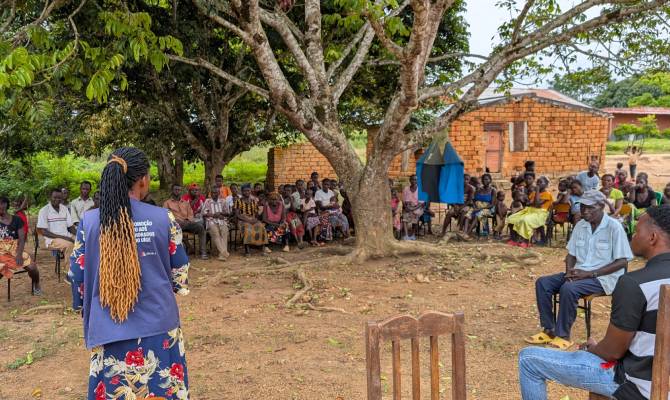
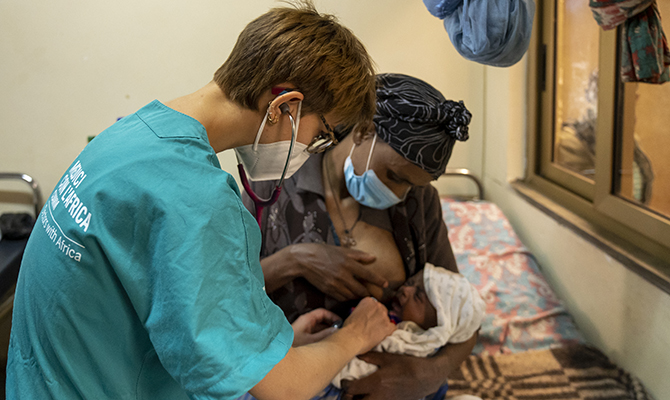
It is precisely on the first of these delays that one of the core activities of the project “Promoting Access to Health and Nutrition Services for Women and Children in the Bossangoa Health District”, supported by the Italian Cooperation, focuses: the training and supervision of matrones communautaires, the traditional midwives. These women are deeply rooted in rural communities, often serving as the first—and sometimes only—point of contact for a pregnant woman living far from a health center.
The goal is to turn them into a true bridge to the formal health system, rather than an alternative to it: they are trained to recognize danger signs during pregnancy and to refer women promptly to health facilities.
“After the training with CUAMM, we clearly understood that our role is to raise awareness and accompany pregnant women and new mothers. We guide them toward antenatal care (ANC), assisted delivery, postnatal care (PNC), and infant vaccinations (EPI). We also offer advice on birth spacing. Our work serves to create a constant bridge between families in the village and the health facility,” stated Marie Louise Namkona, a matron communautaire in the Gbangayanga area, 50 km from Bossangoa.
“The training we received has markedly improved the quality of our awareness-raising work. I feel that my contribution is meaningful because it encourages women to cast aside their hesitation and seek care at the hospital,” added Rachel Doutifio, another traditional midwife from the Ndjongobé area.
Their work is monitored over time through regular supervisory visits by staff from Health Centers and Health Posts, who were themselves previously trained by CUAMM, as took place on July 28 and 29. A group of 34 head nurses from across the region gathered in the training hall of the Yadé health region to acquire the tools and skills needed to effectively guide the matrones communautaires. Two days structured into ten modules covered topics ranging from identifying danger signs in pregnancy to managing obstetric emergencies, from maternal death surveillance to newborn health, alongside practical tools for field monitoring and supervision.
“The impact of this integrated approach is clear: the chain of care between the community and the health facility has been strengthened. Multi-level training creates a shared vision and a spirit of collaboration that was missing before,” continued Christian Gazaworo, supervisor in the Ndjongobé area.
“CUAMM’s initiative has allowed us to carry out our work much more effectively and safely. The impact is visible in our active support: women are no longer alone. We feel that our actions directly contribute to reducing maternal deaths in our area, and this drives us to keep moving forward on this path,” concluded Marie Louise Namkona.
It is a journey designed to build a close-knit, widespread support network that speaks the same language, helping women every day to bridge the distances, both physical and emotional, that still separate them from safe healthcare.
“For the future, the aspect to focus on most, including within community dynamics, is the involvement and training of Community Health Workers (CHWs) and community leaders,” concluded Christian Gazaworo.
Investing in the training of those closest to the community means working directly toward this goal: strengthening a health system that can truly respond to the real needs of the people in the Bossangoa Health District.