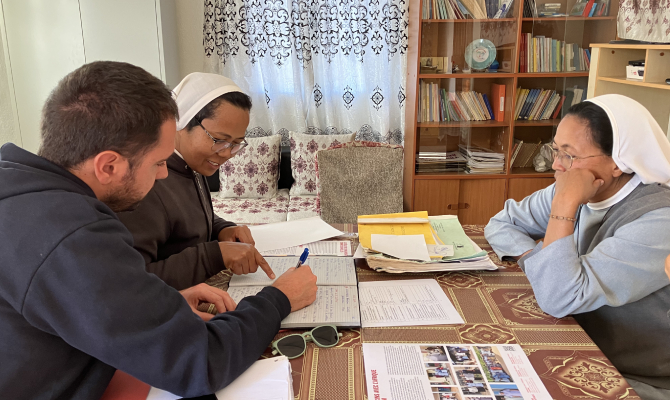
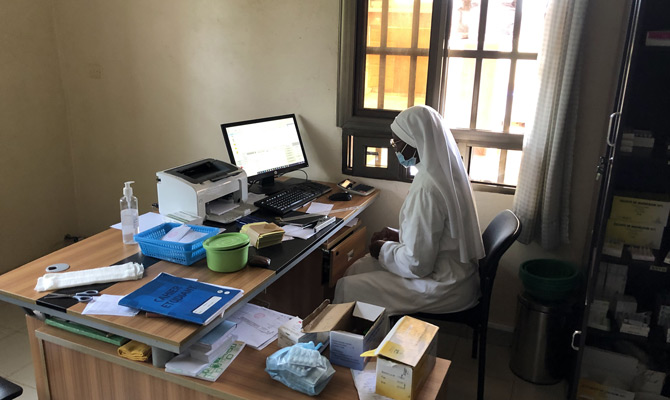
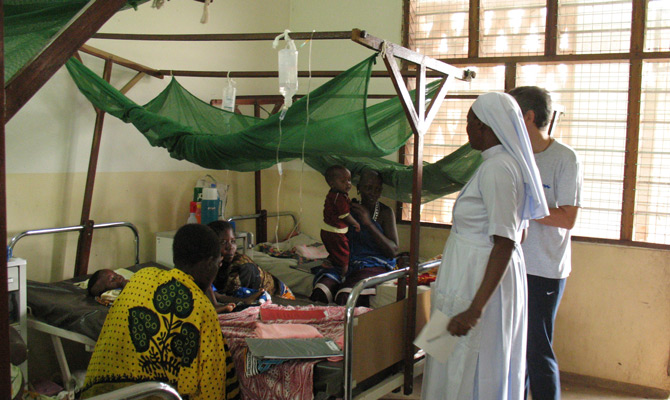
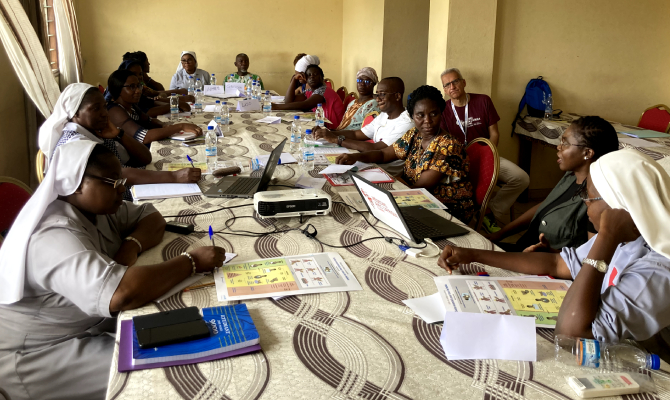
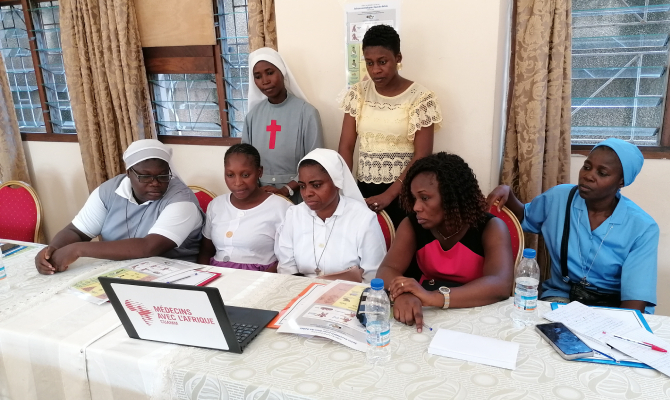
Access to training opportunities is a key step in empowering and strengthening FBOs, yet language barriers can lead to missed opportunities. In order to overcome such challenge and promote equal access to training, Doctors with Africa CUAMM has just held its first french-taught course on leadership and networking skills. The training followed the syllabus of the previous english edition, held in July.
“Opening remarks” Father Dante Carraro – CUAMM Director General
“Connect, strengthen and empower Faith-Based Organisations in delivering healthcare services” Mr. Andrea Atzori – Head of International Relations at CUAMM
“Supporting Faith-Based Organizations delivering Healthcare in Africa” Dr. Parotto – Clinical Advisor and Anesthesiologist, Padua’s University Hospital
“The cycle of the project” Mrs. Anna Cavestro – Project Manager
“Partnerships with Governments & Local Authorities: the experience of UCMB” Dr. Kasyaba – Assistant Executive Secretary of the Uganda Catholic Medical Bureau (UCMB)
«Participants were encouraged to foster a culture of collaboration, to value the contributions of each team member, and to maintain open and transparent communication» stated the Diocesan Director at Centre de Charité Saint Camille de Djougou –Father Yvon Serge Hounsou from Ordre des Serviteurs des malades, Benin.
43 people representing 22 different faith-based organizations from 11 African countries attended the virtual training course organized by CUAMM thanks to the support of the Conrad N. Hilton Foundation. Professionals such as nurses, medical doctors and health facility’s managers were among the learners who were represented by both ordained and no-ordained members of religious congregations.
«This event was a valuable opportunity for participants from various religious institutes to strengthen their skills and knowledge. As the speakers shared their experiences and intervention strategies, we were able to learn in order to prepare ourselves to better serve our communities» said brother Cosimo, nurse from Ordre hospitalier de St. Jean de Dieu, currently serving at Saint Jean De Dieu Hospital Tanguiéta, Benin.
Since 2019, Doctors with Africa CUAMM has been committed to strengthening the capacity and resilience of staff working in faith-based health facilities across the Africa region by offering training packages on different topics including healthcare facilities management, clinical aspects, project management, disaster preparedness and resource mobilization. While the courses were only available in English until now, “Compétences en matière de leadership et de mise en réseau” intends to facilitate access and learningto french speaking professionals deployed in the provision of health care across Africa representing a first step in the promotion of a more inclusive and effective training package. Training activities are promoted in the context of “Supporting FBOs on the frontline of healthcare service delivery in Africa”, the program launched by CUAMM in 2019 with the final goal of strengthening the capacity and resilience of staff working in faith-based health facilities through training, technical assistance and advocacy activities. To date, 150 faith-based organizations located in 26 countries, are involved in the program.
163 people representing 79 different faith-based organizations from across the globe, mainly from the Africa Region, but also Europe, Brazil, Pakistan and USA, subscribed to the online training on Leadership and networking skills organized by CUAMM thanks to the support of the Conrad N. Hilton Foundation.
The training aimed at addressing two fundamental issues: leadership skills and the ability and importance of networking in health cooperation projects, where building strong connections between religious congregations, government partners, and institutions, is crucial.
Despite the key role played by FBOs in the provision of healthcare services to the most vulnerable populations, numerous challenges undermine their capacity and efficiency such as lack of human resources, weak capacity in disaster management and financial constraints. The training moved from the need to strengthen FBOs capacity in building strong collaborations and partnerships that can indeed make a difference in their health service provision therefore in people’s life.
Why is networking so important? How do you find donors? Which are the key to effective health management?
Those and many others were the questions addressed in the training on leadership and networking skills, attended on June 26. Following the opening remarks by CUAMM Director General – Father Dante Carraro, three modules have been offered to the participants:
“Connect, strengthen and empower Faith-Based Organisations in delivering healthcare services” Mr. Andrea Atzori – Head of International Relations at CUAMM
“Supporting Faith-Based Organizations delivering Healthcare in Africa” Dr. Parotto – Clinical Advisor and Anesthesiologist, Padua’s University Hospital
“Partnerships with Governments & Local Authorities: the experience of UCMB” Dr. Kasyaba – Assistant Executive Secretary of the Uganda Catholic Medical Bureau (UCMB)
The training is part of a wider package designed for FBOs representatives aiming at fostering their competencies on multiple aspects ranging from health facility management to disaster preparedness to monitoring and evaluation and more. The activity is promoted by Doctors with Africa CUAMM in the context of “Supporting FBOs on the frontline of healthcare service delivery in Africa” program launched in 2019 with the final goal of strengthening the capacity and resilience of staff working in faith-based health facilities through training, technical assistance and advocacy activities. Since its launch in 2019, 133 faith-based organizations in 26 countries in sub-Saharan Africa have been involved in “Supporting FBOs on the frontline of healthcare service delivery in Africa” program.
Faith-Based organizations (FBOs) are indeed crucial in delivering quality health services to the most vulnerable populations in Africa. Often located in the last mile, FBOs are frequently on the front lines of service delivery; they are in close contact with local communities and can recognize and address the real needs of the poorest, delivering up to 70% of health services in low and middle income countries. However, FBOs are often neglected in terms of supplies, human resources and funding and are not integrated into the healthcare system.
Ensure quality health care at primary level by strengthening the capacities of those deployed on the frontline of healthcare service delivery is key to achieve long-lasting and effective results. This is the commitment leading the partnership between CUAMM and URSSCI, the Union of Religious in Health and Social Affairs in Ivory Coast.
In the last ten years (2012 to 2021), Ivory Coast has made significant progress in maternal, neonatal, and child health. Maternal mortality has decreased from 614 to 385 per 100,000 live births (LB), under-five mortality from 108 to 74 per 1,000 LB, and neonatal mortality from 38 to 30 per 1,000 LB. However, these rates remain high compared to the sustainable development goals (SDG). The leading causes of neonatal deaths are prematurity (31.6%), asphyxia (27.5%), and infections (20.2%) (Ivory Coast’s “Every Newborn” Action Plan 2018-2020). Achieving SDG target 3 by 2030 requires implementing high-impact interventions for mothers, newborns, and children.
In this context of improving neonatal care, the Ministry of Health, Public Hygiene, and Universal Health Coverage (MSHPCMU), through the PNSME and with CUAMM’s support, is implementing the “Health for All” project in 13 Christian faith-based health facilities. This project aims to contribute to improving the quality of health services amidst URSSCI health facilities to serve vulnerable populations, in line with national plans and priorities. Achieving this goal involves training and capacity building for health personnel in charge of managing the health centres.
As part of it, a five-days training course on essential neonatal care and resuscitation was held at the Regional Episcopal Conference of West Africa (CERAO) in Abidjan, in March. The course offered by Doctors with Africa CUAMM and funded by Eni was co-organized by the Coordination Directorate of the National Program for Maternal and Child Health (DC-PNSME).
Thirty healthcare workers from 13 healthcare facilities of the Union of Religious in Health and Social Affairs in Ivory Coast (URSSCI) participated in the training that aimed at strengthening the clinical knowledge and skills of participants in the proper management of newborns. Among the activities performed: newborn resuscitation within the “Golden Minute,” administration of essential newborn care, infections prevention and control.
2 national paediatric trainers from the PNSME in collaboration with 2 international paediatric trainers from CUAMM in-person, engaged the attendees using a participatory approach based on theoretical and practical learning. The theoretical phase was based on teaching techniques including questions and answers, brainstorming, illustrated lectures, and discussions while practical demonstrations on anatomical models supported learning activities on essential care, neonatal resuscitation and nasogastric tube placement.
«The training we are holding are not only a fruitful occasion for health workers and providers to improve their competencies but also a mean to pursue the objectives set by the Ministry of Health who called for quality health services for all» said Dr N’guessan Rebecca paediatrician at PNSME who concluded «By supporting the PNSME in the implementation of this activity, CUAMM is enabling health workers at Primary Contact Public Health Establishments ESPC (Etablissements Sanitaires Publics de Premier contact) to improve the care of mothers, newborns and children»
The participants were assessed through initial, mid-course, and final questionnaires and gained a certificate of participation. The final evaluation highlighted the need to continue the capacity-building process for healthcare workers. Further and regular on-site theoretical and practical training sessions are already scheduled for the next months, in collaboration with the Coordination Directorate of the National Program for Maternal and Child Health and international neonatology experts, in order to improve the capacity of facilities to reduce maternal and neonatal mortality in Ivory Coast.
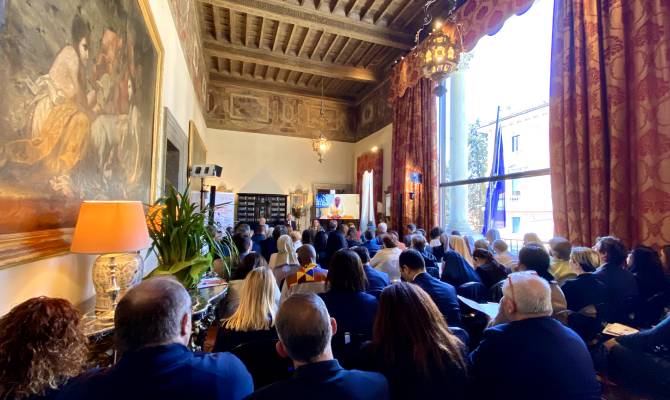
The event “Supporting faith-based organizations on the frontline of healthcare service delivery” organized by Doctors with Africa CUAMM and Embassy of Italy to the Holy See was held today in Rome. The meeting was a valuable occasion for highlighting both the key role FBOs play in the delivery of healthcare services in low and middle income countries (LMIC) and the importance of building strong partnerships. Governments representatives, institutions, partners, private foundations and companies attended the event to prove the value of having a common commitment.
For over a decade, FBOs have been serving the most vulnerable populations in Africa to ensure the access to healthcare services for all. Often located in the last mile, FBOs are frequently on the front lines of service delivery; they are in close contact with local communities and can recognize and address the real needs of the poorest, delivering up to 70% of health services in low and middle income countries. However, FBOs are often neglected in terms of supplies, human resources and funding and are not integrated into the healthcare system.
Doctors with Africa CUAMM believes that FBOs need to be supported and included in local health system strengthening interventions. For that reason, in 2019 CUAMM launched the program “Supporting FBOs on the frontline of healthcare service delivery in Africa” aiming at strengthening the capacity and resilience of staff working in faith-based health facilities through training, technical assistance and advocacy activities.
Since its launch in 2019, 133 faith-based organizations in 26 countries in sub-Saharan Africa have been involved in “Supporting FBOs on the frontline of healthcare service delivery in Africa” program . Up to 164 health facilities have been targeted in numerous on-field visits conducted by CUAMM personnel highly qualified both in health care and health service management. The facilities benefited from CUAMM’s support in terms of training in the field of management and administration, technical assistance through online activities and meeting on the ground; and advocacy to help FBOs share lessons learned and strengthen their representative capacity before local institutions and international community. The event was also a opportunity for presenting a deep analysis on the work FBOs are doing in 11 countries in sub-Saharan Africa.
The meeting started with the opening remarks delivered by the Italian Ambassador to the Holy See, Doctors with Africa CUAMM Director General and Uganda Ministry of Health Representative.
Francesco Di Nitto, Italian Ambassador to the Holy See: «I am honoured for hosting this event here at Palazzo Borromeo. Africa has become a priority for Italy and in particular for this government. Italy is absolutely aware of how interconnected the destinies of Europe and Africa are and that is why it has been working to write a new page in the histyory of cooperation through the launch of Piano Mattei whose main idea is to develop partnership with African countries on equal footing also through FBOs, some of which have been asked to participate actively in the steering committee of Piano Mattei».
Father Dante Carraro, Director General Doctors with Africa CUAMM: «CUAMM, which I am speaking for, is itself a faith based organization. That is why we truly believe in the role FBOs play on the ground, in Africa. They are on the frontline of healthcare service delivery in low and middle income countries (LMIC), they keep up a widely underestimated work, barely recognized that we want to support and amplify».
Tom Aliti, Commissioner Health Services, Health Sector Partners & Multisectoral Coordination, Ministry of Health Uganda: «Ugandan health system is wonderful and strong. We aim at reaching the universal health coverage and in doing that, we are aware of the importance of working with partners such as CUAMM and FBOs which is something we started doing. Both the Government and the Ministry of Health have set a technical working group to jointly identify needs and priorities therefore design responses especially to address the urgent crisis in Sudan which has so far caused 1.5 million refugees, and also the crisis in Central African Republic without forgetting the urgency to plan a response strategy to the rising threat of climate change».
A first panel was dedicated to the role international cooperation agencies have in supporting and promoting healthcare in Africa. In conversation with Gary Cohen – CEO & Co-founder Maternal Newborn Health Innovation, Peter Natiello – USAID and Juliette Prodhan – FCDO highlighted the importance of driving locally targeted interventions for more sustainable and long-lasting results remarking lessons learned over their career in the humanitarian sector.
Peter Natiello, Senior Humanitarian and Development Advisor, USAID’s Bureau of Humanitarian Assistance: «Faith Based Organization have really strong and healthy christian values and those intangible assets are critical to success in development project. And it’s precisely those things and those intangible assets that make faith-based organizations such an important partner to USAID. And just very quickly, I would like to mention the work that USAID is doing in Africa, Uganda, hand-in-hand with CUAMM: that has been critical to strengthen local health systems in those isolated places where precisely the refugees crisis have put additional stress on health systems».
Juliette Prodhan, Deputy Director, Development Policy, UK Foreign Commonwealth and Development Office – FCDO: «The ability of FBOs to link with communities, to influence communities, to influence behaviours is something we have witnessed during Covid epidemic they were on the frontline of vaccination campaign, they role in influencing is very important for us. And also their presence in the last mile, is really important. We need to work with people who understand communities’ dynamics and who serve in the most poor countries where the most fragile are and where we want to develop our projects even further. That is where FBOs are. The ideal would be for States to be accountable to their citizens and for State-citizenship’s relation to be really strong so that in the long run we know we have sustainable interventions».
Not only international cooperation agencies, private foundations also play a crucial role being them capable of delivering financial support to FBOs on the frontline of healthcare service delivery. The second panel “The commitment of private foundations on FBOs work in healthcare” was an enriching opportunity for us all to share objectives, identify common values and set the way further.
Sister Jane Wakahiu, Associate Vice President of Program Operations and Head of Catholic Sisters Initiative at Conrad N. Hilton Foundation: «Today I am delighted about the partnership with Doctors with Africa CUAMM in improving the capacity of our 100 catholic sisters involved in healthcare in Ethiopia and Central African Republic. Strengthening and supporting health facilities run by sisters is crucial for improving health service delivery and fostering striving community».
Filippo Uberti, Head of Health Unit ENI Foundation: «As an international company working in the energy sector we are called to respond to many urgent challenges. Firstly, the challenge of ensuring the health of our workers, their families and communities, secondly the challenge to invest in new model of energy such as renewable energies. The latter is probably the most challenging for us. Yet, we have to address it not only because the connection between environment and human health is something a growing number of governments are sheding a light on but also, because it is our mission to guarantee the well-being of our workers, families and communities across the 72 countries where we work».
Eva Kooijman, Philantropy Officer, Caritas Pro Vitae Gradu Charitable Trust: «FBOs are key actor in reaching their own community. What makes CUAMM a brilliant partner is the capacity to have reached itself 133 FBOs showing us a commitment that was beyond our expectations».
We could not fail to dedicate time to results collected from the assessment visits on the ground. Research is indeed an essential compenent of CUAMM’s work and one much needed to be accountable to partners and communities. That’s why the meeting was also the occasion to present the assessment from the visits conducted over the past 2 years in 64 health facilities across 11 countries in sub-Sahaaran Africa, managed by 48 FBOs.
Emanuela Parotto, Clinical Advisor: «The assessment report we are presenting today provides a critical insight in the challenges faced by FBOs in running health facilities in sub-Sahaaran Africa. The report is meant to underline the need for a long-lasting change in the provision of healthcare services. Through CUAMM visits on the ground, we had the opportunity to see first hand the key role played by FBOs in the provision of healthcare services to the most vulnerable populations despite the numerous challenges such as lack of human resources, weak capacity in disaster management and financial constraints. Collaboration and partnerships can indeed make a difference».
“The role FBOs play in the delivery of quality health services to the most vulnerable” was the latest panel of the meeting, followed by an insightful and thought-provoking Q&A session.
«What we can do together with CUAMM is to amplify the voice of Africa so that its needs become clear to everyone» said Fr. Dumisani Vilakati, Regional Coordinator for Africa, Dicastery for Promoting Integral Human Development. «I know that many colleagues from the Dicastery who are working in Africa, they have the feeling to be unnoticed.We do not talk enough about Africa. We do know that there are many crisis ongoing: in Ukraine and in the Holy Land. Yet, the tremendous time people are experiencing in Sudan, South Sudan and Ethiopia is equally worth our attention. Because wherever a war is, health needs spike and responses are needed» concluded Fr. Dumisani Vilakati.
Suor Adou Adjua Josephine, Secretary of l’Union des Religieux dans la Santé et le Social en Côte d’Ivoire – U.R.S.S.C.I.: «U.R.S.S.C.I was first funded in 2005 but it was 2020 when the government of Ivory Coast recognized the network. Today, nearly 100 health facilities are part of URSSCI counting both general hospital and first level health facilities located in remote villages. The mission that we all share as member, is to improve the quality of health services provided within the centres and to facilitate access to healthcare services especially to those most in need. In order to achieve our goal, we need first and foremost to be trained. Training is key and we need to improve our capacity in management, administration, law, healthcare service provision, communication and visibility, technical assistance. Just to mention a few. URSSCI is becoming more and more important to represent FBOs health facilities before the Ministry of Health and to have a seat at the table».
To conclude the event, Andrea Atzori, Head of International Relations, Doctors with Africa CUAMM gave the participants an overview of the major current challenges stressing the urgent need to build strong connection because «today Africa, or we’d better say the whole world is experiencing numerous crisis to which none of us alone can provide a response». Among the main ones underlined: the climate crisis, the economic crisis and the numerous huminatrian crisis ongoing. «“Partnership” is the key word: it is urgent to build connections as these that I see here, right in this room where we have gathered with partner, governments, FBOs, companies and private foundations. We have to debunk the myth that funds and money can drive change. It is a misconception. Financial support is without any doubt needed but it only become effective when it does change people’s lives, also in the hardest to reach areas» concluded Atzori.
The activities implemented in collaboration with Governments and local communities are supported by Hilton Foundation, Caritas Pro Vitae, Vitol Foundation and Eni Foundation.